Search

Wednesday, 8 January 2020

Newmont ups dividend by 79 per cent as gold prices surge


Newmont will increase its quarterly dividend by 79 per cent, the world’s largest gold miner said on Monday, as gold prices surged toward a seven-year high.


The Colorado-based miner said its dividend would rise to 25 cents a share starting in the quarter ending April 2020, or $1 a share on an annualised basis.

Gold hit its highest level since April 2013 on Monday, of $1,579.72 a troy ounce, due to rising tensions in the Middle East following the US assassination of a top Iranian general in Iraq.

Newmont also said it will continue its stock buyback plan, with a target to buy back $1bn worth of equity. In the quarter ending December 31, Newmont spent $506m buying back shares, it said.

Shares in Newmont rose 1.3 per cent to $43.39 in morning trading on the news.

Newmont ups dividend by 79 per cent as gold prices surge

Friday, 19 October 2018

Of a King and his newly-found Heroism

 The Journey of August King
 
Have you ever found yourself in a setup that you weren't set up to be in? And after two innocent steps in you found yourself getting in deeper? And there you found yourself deep in a matter of conscience....

The year is 1815 and we are deep in North Carolina next to the Appalachians. This is only a few years after the west of the ranges was mapped by Lewis and Clark so this region is still fresh of human settlement.

King, first name August, is a widower played by Jason Patric. He lives a pretty unremarkable life on the backside of the mountains. His three-day journey to the nearest marketplace sets him on an encounter that he will remember the rest of his life. 

On his way back to his farm he meets an escaped slave girl who is being sought for by her ruthless owner, Olaf Singletary (Larry Drake).

Annalees (Thandie Newton) is running away to save her soul, she says. Olaf is also after her brother who is beheaded as soon as he's caught.

Despite his initial hesitation, King resolves to help Annalees escape to the North. They have to go through several close shaves and it's a pity that this picturesque country is the backdrop for a story that portrays how distasteful and heart-wrenching greed can be. Especially for the people of colour discriminated against for more than 400 years of American history.

This gem of a story was released back in 1995 by Miramax.

Tuesday, 1 October 2013

BP facing huge fines as oilspill trial resumes

Attorney: Oil Giant lied about Blowout

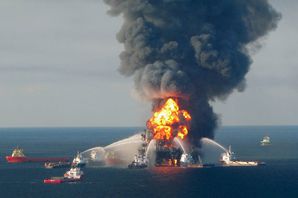
British petroleum giant, BP, is facing fines of up to $18bn when the trial over the 2010 DeepWater Horizon disaster resumes in New Orleans.

Plaintiffs' attorney Brian Barr told the court Monday that BP lied about 'how much oil was flowing from the well.' He added that the company was ill-prepared for the accident.


The Department of Justice claims that 4.2m barrels spilled from the
Water Horizon well
However, BP attorney Mike Brock told the court that the company made 'extraordinary' efforts to stop the oil spill and did not hide the flow rate in a way that delayed efforts to minimize the disaster's effects.

US district judge Carl Barbier is set to begin the second phase of the trial which will cover the magnitude of the oil spill and BP's efforts to mitigate its effects. This phase will last for 14 days.

According to UK newspaper, the Guardian, the US Department of Justice claims that 4.2m barrels spilled from the well while BP counters that only 2.4m barrels. The outflow resulted in a fiery explosion that led to 11 deaths.


Oil spills during the July 2010 disaster.
Judge Barbier is set to conclude whether BP's behavior resulted in gross negligence. If found guilty, BP and its partners will be liable to the tune of $ 1,100 per barrel. The figure could rise to $ 4,300 under the Clean Water Act which imposes the fine due to gross negligence or willful misconduct.
Meanwhile, some of BP's former partners such as Transocean and Halliburton are now demanding that the oil giant pay the larger share of the fines. The partners say that BP could have sealed the well on May 15 2010 but did not. They claim that their liability is limited to the outflow before that date.

Friday, 31 May 2013

Apple Inc. walking on thin 'tax ice'

iCompanies allegedly assisting in tax avoidance 


Silicon Valley computer giant, Apple Inc., has come under unwanted attention in the last few weeks after it was revealed that the US Senate is investigating it for tax avoidance. Senate officials have been particularly concerned about the company's operations in Ireland where profits from other operations in the world have been diverted to in a bid to pay less to the taxman.

According to a UK newspaper report, the investigations have focused on a group of companies registered at Apple's Cork office. The Guardian reports that although the company's holding company in the Irish city had no physical presence or employees, it made nearly $30bn in profit in four years. One of the Senate officials joked that the holding company, Apple Operations International, and others were iCompanies- i for imaginary, invisible.

An Irish accountant, Cathy Kearney, is listed as AOP's director and appears to be the only member of the board based in Ireland. The other directors are based in California. The report suggests that Kearney's directorships help satisfy Irish incorporation requirements.

However, some of the Apple companies in focus do not have tax residency anywhere in the would Kearney oversees Apple operations in Cork which means she is responsible for sales of iPads, iPhones and MacBooks to African, European and Middle Eastern markets. These markets accounted for two-thirds of the group's profits in 2011, about $22bn.

Friday, 5 April 2013

Sale of Kyrgyzstan's Jeeroy Gold Deposit Begins

The government of Kyrgyzstan has commenced the sale of a gold deposit located in the country's Talas region. In a statement in official newspapers, the government states that tendering will proceed until May 10 with a starting bid of $300m. The announcement comes at a time when the Kygyz government is facing a $400m claim from a Kazakh company.

Workers stand beside machinery in a tunnel in the Kumtor mine in Kyrgyzstan 

Visor Holdings of Kazakhstan claims that its licence was revoked improperly in 2010 for what the Kyrgyz government said was 'failure to begin gold production'.

Visor previously held a 60% stake in a joint venture with Kyrgyzstan at Jeeroy. Sources at Visor say that tens of millions had already been invested before the licence was revoked.


The issue is being arbitrated at a US court.

According to Kyrgyzaltyn, the state gold company, the Jeeroy mine holds at least 84 tonnes of gold in addition to 13 tonnes of silver. The gold deposit is the country's second-largest and lies about 3000 metres above sea-level. The largest deposit, Kumtor, is also at the center of a dispute between the government and Canadian developer Centerra Gold.

The winner of the auction will be awarded a mining licence only and the state geological agency does anticipate obstacles for the winner in the form of property rights disputes.

(Source: Olga Dzyubenko, Reuters)

Thursday, 4 April 2013

BP Oil Spill: Oil Giant Disputes Pay-Offs

The Deepwater Horizon rig burns up in this April 2010 photo
British oil giant BP plc  has disputed the amounts being paid out for compensation with regard to the DeepWater Horizon oil spill. The oil company claims that the arbitrator who is settling the case has been paying out 'fictitious' claims. The oil company says that the independent administrator is allowing businesses to claim excessively favourable revenues and costs for the periods before and after the April 2010 accident.
 The company filed to have an injunction to stop Louisiana lawyer Patrick Juneau from paying out the claims. On Monday, lawyers representing the plaintiffs sought to have the injunction request quashed on the grounds that BP to make its compensation calculations more favourable. The company has had two similar attempts quashed previously, the plaintiff's lawyers say.
In a filing made on Monday,
the plaintiffs' lawyers added that Mr. Juneau was just following the settlement agreement.
Two of the biggest beneficiaries of the payments are law firms and construction companies, the oil giant claims. In a rejoinder, the plaintiffs' lawyers say that BP chose not to exclude certain industries from the compensation plan.
The settlement dispute will be heard on Friday in a New Orleans court.
(Source: Ed Crooks, ft.com)

Tuesday, 19 February 2013

Security group suspects Chinese military is behind hacking attacks


A Chinese People's Liberation Army soldier stands guard in front of 'Unit 61398', a secretive Chinese military unit, in the outskirts of Shanghai, February 19, 2013. The unit is believed to be behind a series of hacking attacks, a U.S. computer security company said, prompting a strong denial by China and accusations that it was in fact the victim of U.S. hacking. REUTERS/Carlos Barria
A Chinese soldier stands in front of the headquarters of secretive millitary 'Unit 61398' in the outskirts of Shanghai
(Reuters) - A secretive Chinese military unit is believed to be behind a series of hacking attacks, a U.S. computer security company said, prompting a strong denial by China and accusations that it was in fact the victim of U.S. hacking.
The company, Mandiant, identified the People's Liberation Army's Shanghai-based Unit 61398 as the most likely driving force behind the hacking. Mandiant said it believed the unit had carried out "sustained" attacks on a wide range of industries.
"The nature of 'Unit 61398's' work is considered by China to be a state secret; however, we believe it engages in harmful 'Computer Network Operations'," Mandiant said in a report released in the United States on Monday.
"It is time to acknowledge the threat is originating in China, and we wanted to do our part to arm and prepare security professionals to combat that threat effectively," it said.
China's Defense Ministry issued a flat denial of the accusations and called them "unprofessional". It said hacking attacks are a global problem and that China is one of world's biggest victims of cyber assaults.
"The Chinese army has never supported any hacking activity," the Defense Ministry said in a brief faxed statement to Reuters. "Statements about the Chinese army engaging in cyber attacks are unprofessional and not in line with facts."
Unit 61398 is located in Shanghai's Pudong district, China's financial and banking hub, and is staffed by perhaps thousands of people proficient in English as well as computer programming and network operations, Mandiant said in its report.
The unit had stolen "hundreds of terabytes of data from at least 141 organizations across a diverse set of industries beginning as early as 2006", it said.
Most of the victims were located in the United States, with smaller numbers in Canada and Britain. The information stolen ranged from details on mergers and acquisitions to the emails of senior employees, the company said.
The 12-storey building, which houses the unit, sits in an unassuming residential area and is surrounded by a wall adorned with military propaganda photos and slogans; outside the gate a sign warns members of the public they are in a restricted military area and should not take pictures.
There were no obvious signs of extra security on Tuesday.
The Chinese Foreign Ministry said the government firmly opposed hacking, adding that it doubted the evidence provided in the U.S. security group's report.
"Hacking attacks are transnational and anonymous. Determining their origins are extremely difficult. We don't know how the evidence in this so-called report can be tenable," spokesman Hong Lei told a daily news briefing.
"Arbitrary criticism based on rudimentary data is irresponsible, unprofessional and not helpful in resolving the issue."
Hong cited a Chinese study which pointed to the United States as being behind hacking in China.
"Of the above mentioned Internet hacking attacks, attacks originating from the United States rank first."

"ECONOMIC CYBER ESPIONAGE"
Some experts said they doubted Chinese government denials.
"The PLA plays a key role in China's multi-faceted security strategy, so it makes sense that its resources would be used to facilitate economic cyber espionage that helps the Chinese economy," said Dmitri Alperovitch, chief technology officer and co-founder of CrowdStrike, one of Mandiant's competitors.
Though privately held and little known to the general public, Mandiant is one of a handful of U.S. cyber-security companies that specialize in attempting to detect, prevent and trace the most advanced hacking attacks, instead of the garden-variety viruses and criminal intrusions that befoul corporate networks on a daily basis.
But Mandiant does not promote its analysis in public and only rarely issues topical papers about changes in techniques or behaviors.
It has never before given the apparent proper names of suspected hackers or directly tied them to a military branch of the Chinese government, giving the new report special resonance.
The company published details of the attack programs and dummy websites used to infiltrate U.S. companies, typically via deceptive emails.
U.S. officials have complained in the past to China about sanctioned trade-secret theft, but have had a limited public record to point to.
Mandiant said it knew the PLA would shift tactics and programs in response to its report but concluded that the disclosure was worth it because of the scale of the harm and the ability of China to issue denials in the past and duck accountability.
The company traced Unit 61398's presence on the Internet - including registration data for a question-and-answer session with a Chinese professor and numeric Internet addresses within a block assigned to the PLA unit - and concluded that it was a major contributor to operations against the U.S. companies.
Members of Congress and intelligence authorities in the United States have publicized the same general conclusions: that economic espionage is an official mission of the PLA and other elements of the Chinese government, and that hacking is a primary method.
In November 2011, the U.S. National Counterintelligence Executive publicly decried China in particular as the biggest known thief of U.S. trade secrets.
The Mandiant report comes a week after U.S. President Barack Obama issued a long-awaited executive order aimed at getting the private owners of power plants and other critical infrastructure to share data on attacks with officials and to begin to follow consensus best practices on security.
Both U.S. Democrats and Republicans have said more powerful legislation is needed, citing Chinese penetration not just of the largest companies but of operations essential to a functioning country, including those comprising the electric grid.

(Additional reporting by Michael Martina and Koh Gui Qing in BEIJING, Carlos Barria in SHANGHAI and Jim Finkle in BOSTON; Editing by Robert Birsel and Sanjeev Miglani)

Thursday, 6 December 2012

Northern Canada eyes BP oil spill technology


CALGARY, Alberta, Dec 5 (Reuters) - Canada's Northwest Territories is studying oil well monitoring technology used by BP Plc in the Gulf of Mexico following its 2010 oil spill there in hopes that it can be applied to Arctic wells, the Territories' industry minister said on Wednesday.

David Ramsay, minister of industry, tourism and investment in the resource-rich and sparsely populated territory, said it may be possible that such gear can be used to satisfy Canadian regulators, who reviewed regulations for offshore oil and gas operations in the Arctic following BP's Macondo disaster.
Ramsay toured BP monitoring facilities this week in Houston, where he also spoke at an event hosted by the Canadian consulate.

The Northwest Territories is seeking investments in oil and gas as a way to bring economic benefits to a region that suffers from high unemployment. A long-sought pipeline to move gas from the onshore Mackenzie Delta to southern markets is years behind schedule.

"They (BP) are going to be a player in the Beaufort, in the Arctic, so it's important for us to meet with them to get an understanding of how they are going to try to address the same-season relief well requirements," he told Reuters in a telephone interview.

After its review, Canada's National Energy Board reaffirmed a long-standing policy that requires drillers in the Far North offshore to demonstrate that they can drill a relief well during the same season of its initial well in case of a blowout.

The NEB said, however, that applicants wanting to depart from the rule would have to show how they would meet or exceed the policy's intended outcome, aimed at protecting the environment in the fragile region from contamination.

Ramsay said it is important for the territorial government to see what might be available as far as offering "equivalencies" to same-season relief wells.

He was shown BP's monitoring stations and a capping stack, a massive steel structure like the one the company used to finally cap the blown-out Macondo well that spewed nearly 5 million barrels of oil into the Gulf of Mexico for almost three months.

Last month BP agreed to pay $4.5 billion in penalties and plead guilty to criminal misconduct over the disaster, which caused the worst offshore oil spill in U.S. history.
As part of a deal announced in 2010, BP pooled its Canadian Beaufort acreage with that held by Exxon Mobil Corp and Imperial Oil Ltd. The aim was to avoid duplication of equipment and personnel.
The partners are currently assessing options for exploring and developing the acreage, but there are no current plans to start drilling, Imperial spokesman Pius Rolheiser said.
"We hope to someday have activity back in the Canadian Beaufort and be able to look at monitoring the in the Beaufort in the Northwest Territories," Ramsay said.
Chevron Corp has been conducting seismic studies in the region and expects to return in the summer of 2013, and a small British company, Franklin Petroleum, is also devising a seismic program for next season, he said.
In his speech on Wednesday, Ramsay said the Northwest Territories has an estimated 81 trillion cubic feet of natural gas and almost seven billion barrels of oil.
The trick has been developing the resources and getting them to market. The Imperial-led Mackenzie Valley Pipeline is stalled against a backdrop of weak natural gas prices and booming shale gas supplies closer to market.

The government is optimistic, however, about the Conol shale oil formation near Norman Wells in the central Mackenzie Valley, where companies such as Husky Energy Inc, Royal Dutch Shell Plc, ConocoPhillips and MGM Energy Corp have launched exploration programs to tap an estimated two billion to three billion barrels of crude.