Search

Friday, 5 April 2013

Sale of Kyrgyzstan's Jeeroy Gold Deposit Begins

The government of Kyrgyzstan has commenced the sale of a gold deposit located in the country's Talas region. In a statement in official newspapers, the government states that tendering will proceed until May 10 with a starting bid of $300m. The announcement comes at a time when the Kygyz government is facing a $400m claim from a Kazakh company.

Workers stand beside machinery in a tunnel in the Kumtor mine in Kyrgyzstan 

Visor Holdings of Kazakhstan claims that its licence was revoked improperly in 2010 for what the Kyrgyz government said was 'failure to begin gold production'.

Visor previously held a 60% stake in a joint venture with Kyrgyzstan at Jeeroy. Sources at Visor say that tens of millions had already been invested before the licence was revoked.


The issue is being arbitrated at a US court.

According to Kyrgyzaltyn, the state gold company, the Jeeroy mine holds at least 84 tonnes of gold in addition to 13 tonnes of silver. The gold deposit is the country's second-largest and lies about 3000 metres above sea-level. The largest deposit, Kumtor, is also at the center of a dispute between the government and Canadian developer Centerra Gold.

The winner of the auction will be awarded a mining licence only and the state geological agency does anticipate obstacles for the winner in the form of property rights disputes.

(Source: Olga Dzyubenko, Reuters)

Thursday, 4 April 2013

BP Oil Spill: Oil Giant Disputes Pay-Offs

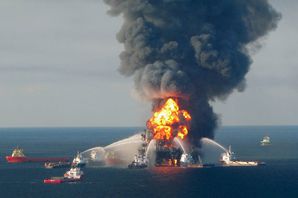
The Deepwater Horizon rig burns up in this April 2010 photo
British oil giant BP plc  has disputed the amounts being paid out for compensation with regard to the DeepWater Horizon oil spill. The oil company claims that the arbitrator who is settling the case has been paying out 'fictitious' claims. The oil company says that the independent administrator is allowing businesses to claim excessively favourable revenues and costs for the periods before and after the April 2010 accident.
 The company filed to have an injunction to stop Louisiana lawyer Patrick Juneau from paying out the claims. On Monday, lawyers representing the plaintiffs sought to have the injunction request quashed on the grounds that BP to make its compensation calculations more favourable. The company has had two similar attempts quashed previously, the plaintiff's lawyers say.
In a filing made on Monday,
the plaintiffs' lawyers added that Mr. Juneau was just following the settlement agreement.
Two of the biggest beneficiaries of the payments are law firms and construction companies, the oil giant claims. In a rejoinder, the plaintiffs' lawyers say that BP chose not to exclude certain industries from the compensation plan.
The settlement dispute will be heard on Friday in a New Orleans court.
(Source: Ed Crooks, ft.com)

Tuesday, 19 February 2013

Security group suspects Chinese military is behind hacking attacks


A Chinese People's Liberation Army soldier stands guard in front of 'Unit 61398', a secretive Chinese military unit, in the outskirts of Shanghai, February 19, 2013. The unit is believed to be behind a series of hacking attacks, a U.S. computer security company said, prompting a strong denial by China and accusations that it was in fact the victim of U.S. hacking. REUTERS/Carlos Barria
A Chinese soldier stands in front of the headquarters of secretive millitary 'Unit 61398' in the outskirts of Shanghai
(Reuters) - A secretive Chinese military unit is believed to be behind a series of hacking attacks, a U.S. computer security company said, prompting a strong denial by China and accusations that it was in fact the victim of U.S. hacking.
The company, Mandiant, identified the People's Liberation Army's Shanghai-based Unit 61398 as the most likely driving force behind the hacking. Mandiant said it believed the unit had carried out "sustained" attacks on a wide range of industries.
"The nature of 'Unit 61398's' work is considered by China to be a state secret; however, we believe it engages in harmful 'Computer Network Operations'," Mandiant said in a report released in the United States on Monday.
"It is time to acknowledge the threat is originating in China, and we wanted to do our part to arm and prepare security professionals to combat that threat effectively," it said.
China's Defense Ministry issued a flat denial of the accusations and called them "unprofessional". It said hacking attacks are a global problem and that China is one of world's biggest victims of cyber assaults.
"The Chinese army has never supported any hacking activity," the Defense Ministry said in a brief faxed statement to Reuters. "Statements about the Chinese army engaging in cyber attacks are unprofessional and not in line with facts."
Unit 61398 is located in Shanghai's Pudong district, China's financial and banking hub, and is staffed by perhaps thousands of people proficient in English as well as computer programming and network operations, Mandiant said in its report.
The unit had stolen "hundreds of terabytes of data from at least 141 organizations across a diverse set of industries beginning as early as 2006", it said.
Most of the victims were located in the United States, with smaller numbers in Canada and Britain. The information stolen ranged from details on mergers and acquisitions to the emails of senior employees, the company said.
The 12-storey building, which houses the unit, sits in an unassuming residential area and is surrounded by a wall adorned with military propaganda photos and slogans; outside the gate a sign warns members of the public they are in a restricted military area and should not take pictures.
There were no obvious signs of extra security on Tuesday.
The Chinese Foreign Ministry said the government firmly opposed hacking, adding that it doubted the evidence provided in the U.S. security group's report.
"Hacking attacks are transnational and anonymous. Determining their origins are extremely difficult. We don't know how the evidence in this so-called report can be tenable," spokesman Hong Lei told a daily news briefing.
"Arbitrary criticism based on rudimentary data is irresponsible, unprofessional and not helpful in resolving the issue."
Hong cited a Chinese study which pointed to the United States as being behind hacking in China.
"Of the above mentioned Internet hacking attacks, attacks originating from the United States rank first."

"ECONOMIC CYBER ESPIONAGE"
Some experts said they doubted Chinese government denials.
"The PLA plays a key role in China's multi-faceted security strategy, so it makes sense that its resources would be used to facilitate economic cyber espionage that helps the Chinese economy," said Dmitri Alperovitch, chief technology officer and co-founder of CrowdStrike, one of Mandiant's competitors.
Though privately held and little known to the general public, Mandiant is one of a handful of U.S. cyber-security companies that specialize in attempting to detect, prevent and trace the most advanced hacking attacks, instead of the garden-variety viruses and criminal intrusions that befoul corporate networks on a daily basis.
But Mandiant does not promote its analysis in public and only rarely issues topical papers about changes in techniques or behaviors.
It has never before given the apparent proper names of suspected hackers or directly tied them to a military branch of the Chinese government, giving the new report special resonance.
The company published details of the attack programs and dummy websites used to infiltrate U.S. companies, typically via deceptive emails.
U.S. officials have complained in the past to China about sanctioned trade-secret theft, but have had a limited public record to point to.
Mandiant said it knew the PLA would shift tactics and programs in response to its report but concluded that the disclosure was worth it because of the scale of the harm and the ability of China to issue denials in the past and duck accountability.
The company traced Unit 61398's presence on the Internet - including registration data for a question-and-answer session with a Chinese professor and numeric Internet addresses within a block assigned to the PLA unit - and concluded that it was a major contributor to operations against the U.S. companies.
Members of Congress and intelligence authorities in the United States have publicized the same general conclusions: that economic espionage is an official mission of the PLA and other elements of the Chinese government, and that hacking is a primary method.
In November 2011, the U.S. National Counterintelligence Executive publicly decried China in particular as the biggest known thief of U.S. trade secrets.
The Mandiant report comes a week after U.S. President Barack Obama issued a long-awaited executive order aimed at getting the private owners of power plants and other critical infrastructure to share data on attacks with officials and to begin to follow consensus best practices on security.
Both U.S. Democrats and Republicans have said more powerful legislation is needed, citing Chinese penetration not just of the largest companies but of operations essential to a functioning country, including those comprising the electric grid.

(Additional reporting by Michael Martina and Koh Gui Qing in BEIJING, Carlos Barria in SHANGHAI and Jim Finkle in BOSTON; Editing by Robert Birsel and Sanjeev Miglani)

Thursday, 6 December 2012

Northern Canada eyes BP oil spill technology


CALGARY, Alberta, Dec 5 (Reuters) - Canada's Northwest Territories is studying oil well monitoring technology used by BP Plc in the Gulf of Mexico following its 2010 oil spill there in hopes that it can be applied to Arctic wells, the Territories' industry minister said on Wednesday.

David Ramsay, minister of industry, tourism and investment in the resource-rich and sparsely populated territory, said it may be possible that such gear can be used to satisfy Canadian regulators, who reviewed regulations for offshore oil and gas operations in the Arctic following BP's Macondo disaster.
Ramsay toured BP monitoring facilities this week in Houston, where he also spoke at an event hosted by the Canadian consulate.

The Northwest Territories is seeking investments in oil and gas as a way to bring economic benefits to a region that suffers from high unemployment. A long-sought pipeline to move gas from the onshore Mackenzie Delta to southern markets is years behind schedule.

"They (BP) are going to be a player in the Beaufort, in the Arctic, so it's important for us to meet with them to get an understanding of how they are going to try to address the same-season relief well requirements," he told Reuters in a telephone interview.

After its review, Canada's National Energy Board reaffirmed a long-standing policy that requires drillers in the Far North offshore to demonstrate that they can drill a relief well during the same season of its initial well in case of a blowout.

The NEB said, however, that applicants wanting to depart from the rule would have to show how they would meet or exceed the policy's intended outcome, aimed at protecting the environment in the fragile region from contamination.

Ramsay said it is important for the territorial government to see what might be available as far as offering "equivalencies" to same-season relief wells.

He was shown BP's monitoring stations and a capping stack, a massive steel structure like the one the company used to finally cap the blown-out Macondo well that spewed nearly 5 million barrels of oil into the Gulf of Mexico for almost three months.

Last month BP agreed to pay $4.5 billion in penalties and plead guilty to criminal misconduct over the disaster, which caused the worst offshore oil spill in U.S. history.
As part of a deal announced in 2010, BP pooled its Canadian Beaufort acreage with that held by Exxon Mobil Corp and Imperial Oil Ltd. The aim was to avoid duplication of equipment and personnel.
The partners are currently assessing options for exploring and developing the acreage, but there are no current plans to start drilling, Imperial spokesman Pius Rolheiser said.
"We hope to someday have activity back in the Canadian Beaufort and be able to look at monitoring the in the Beaufort in the Northwest Territories," Ramsay said.
Chevron Corp has been conducting seismic studies in the region and expects to return in the summer of 2013, and a small British company, Franklin Petroleum, is also devising a seismic program for next season, he said.
In his speech on Wednesday, Ramsay said the Northwest Territories has an estimated 81 trillion cubic feet of natural gas and almost seven billion barrels of oil.
The trick has been developing the resources and getting them to market. The Imperial-led Mackenzie Valley Pipeline is stalled against a backdrop of weak natural gas prices and booming shale gas supplies closer to market.

The government is optimistic, however, about the Conol shale oil formation near Norman Wells in the central Mackenzie Valley, where companies such as Husky Energy Inc, Royal Dutch Shell Plc, ConocoPhillips and MGM Energy Corp have launched exploration programs to tap an estimated two billion to three billion barrels of crude.

Friday, 2 November 2012

An Overview of the Mobile Phone Industry in Kenya

When the cellphone first landed on Africa's shores in the late 90s, no-one could have expected its use would have exceeded 70% of the population in just a decade. Although this figure is debatable, it certainly holds true for most of Africa's urban areas.

Ethically, mobile phone operators are wont to spread usage to the rural areas. However, this may not be commercially viable as penetration may not yield matching revenues. This means that the operators' core market, the urban areas, may already be saturated and future growth prospects minimised.
The competition for this market in Kenya has been especially heated and now resembles a Red Ocean with competitors going for each others' share.
The only logical way to sustain revenue growth is for operators to concentrate on improving services to this segment and explore ways to expand it.
Kenya currently has 4 service providers- Airtel, Orange, Safaricom and Yu. This is unlike other countries in the region that have upto 6 providers.

Leading Competitors

Safaricom was first off the blocks in the industry and now has the lion's share of the market with over 70% of phone users on its network. Call quality on its network is satisfactory but its coverage like its competitors is limited to the densely populated areas of the country. In the northern region where insecurity is rampant, the 4 companies have shied away from erecting boosters and the available ones are few and far between Safaricom's media presence is more pronounced than its competitors and this is probably what has helped it maintain loyalty among its customers. Its management has also taken the lead in embracing the innovation and the company was among the first in the world to adopt and popularise mobile money-transfer technology.
In the early days of mobile telephony, Safaricom received healthy competition from Kencell Communications which is currently Airtel. Kencell's management had a very competitive and efficient media presence that is not matched by the current competitors. Unfortunately, the company has changed hands severally since then and this has inevitably affected its competitiveness. It now comes 2nd to Safaricom in terms of market share with less than 20%. It's also unfortunate that its call quality was previously regarded as the best in the country. It has also found itself lagging behind Orange and Safaricom in regards to the new frontier in the industry- provision of internet/broadband.

Sick Man of the Industry

Orange-Telkom is the sick man of the industry which is not surprising given its backing. Government backing more often than not means that good management is compromised by bad politics. It has all the resources to make it an industry leader and even has boosters in the remotest parts of the country but all its efforts to redeem itself always come unstuck. I t could have a monopoly in the remotest parts due to its CDMA technology but doesn't take advantage of that.It also has a monopoly in the landlines sector but its service here doesn't deserve mention in the 21st Century- most customers despaired long ago and discarded their old telephones. Another area it displays its lethargy is the broadband segment. Orange-Telkom has a potentially controlling stake in the fiber optic cable that connects Kenya to the rest of the world but won't use it. It's technical staff are knowledgeable and its back office skilled but bureaucracy can't let this company take advantage.
It recently applied for a government bail-out and was successful at the 2nd attempt. The rest of the competition doesn't seem to have the same financial issues but state-backed companies have seen a rise in cases requiring bail-outs. South African Airways recently applied for a bailout from its government after failing to meet its obligations.
Yu is the 4th operator and revels in market penetration pricing to gain market share- a strategy that seems to be working.
Airtel and Orange outsource their customer care departments and this is where they might be shooting themselves in the feet. Most of the outsourcing firms have financial troubles o their own. Their staff are demoralised, underpaid and have been in the spotlight recently after going on strike for unpaid salaries. Surprisingly, these 2 have skilled personnel expatriated from parent companies in more developed countries- India and France respectively but they aren't able to replicate their expertise into success in the local industry- at least not yet.

Thursday, 4 October 2012

Rosneft CEO to meet investors in London on Friday


MOSCOW | Tue Oct 2, 2012 10:07am EDT
 

Oct 2 (Reuters) - Igor Sechin, chief executive of Rosneft, a contender to buy BP's stake in a Russian rival TNK-BP, will meet with minority shareholders in London on Friday, a Rosneft spokesman said.

"It is part of our regular roadshow, which we conduct every year," the spokesman said. He said Sechin would meet with the company's shareholders but would not meet with any BP investors.

The CEO has said BP could use some proceeds from a planned sale of its stake in TNK-BP, its Russian joint venture, to buy a direct equity stake in Rosneft. The spokesman said Sechin was not planning to discuss that deal with investors on Friday.

Rosneft, Russia's largest oil company, is still majority-owned by the state but is on a list of companies to be fully-privatised. But Sechin, a deputy prime minister in the cabinet of Vladimir Putin before Putin was elected president in March, has said he wants to raise the market value of Rosneft before plans are put in motion to privatise it.

Monday, 1 October 2012

Australia's Arrium rejects $1 billion bid from Noble, POSCO group; shares soar


 SYDNEY/MELBOURNE | Mon Oct 1, 2012 12:28am EDT
 

(Reuters) - Australian miner and steel maker Arrium rejected a A$1.01 billion ($1.04 billion) takeover offer from a consortium including Noble Group and POSCO calling the approach undervalued.
Arrium's shares jumped as much as 29 percent on Monday to a one-month high as investors anticipated the company would remain in play. The bidding consortium, called Steelmakers Australia, is expected to respond to the rebuff on Monday afternoon.
The consortium, which also includes National Pension Service of Korea, Korea Investment Corp and Korea Finance Corp, offered 75 cents a share or a 37.6 percent premium to Arrium's close on Friday. Arrium's shares traded above A$0.75 as recently as August 29.
The consortium joins a string of firms aiming to cash in on a drop in the value of resource firms due to tumbling commodities prices. Its bid comes just weeks after Arrium produced its first iron ore from its expanded production.
"There has been a lot of consolidation in the global steel industry for a long time. This is a further working through of the globalization of the industry," said Richard Morrow, director at E.L. & C. Baillieu Stockbroking in Melbourne.
The bid propelled larger rival BlueScope Ltd's (BSL.AX) shares up as much as 8 percent on Monday on hopes of further consolidation in the sector.
A shake-out from sliding iron ore and coal prices has touched off a spate of asset sales as tough times spread from Australia to Indonesia in what has been a lean year in the mining sector.
Iron ore prices, while recovering from a low of $86 a metric ton, remain nearly a third below this year's high of $150 a metric ton as Chinese demand cools. This has rattled share prices, and forced miners including BHP Billiton to put some expansion on hold.
Asia-Pacific mining deals so far this year total $47.6 billion, down 23 percent from a year earlier, Thomson Reuters data shows, but signs of a revival in appetite were evident as near record-low valuations spur deals.
Cashed-up Japanese, Korean and Chinese buyers are cherry-picking mining assets, investment bankers and lawyers say.
Activity has picked up in recent weeks, led by a $960 million bid by Thai state-controlled energy company PTT to privatize coal miner Sakari Resources .
POSCO and others are in talks to buy a 20 percent stake in PT Borneo, which aims to reduce $1 billion in debt incurred last year when it bought a stake in London-listed Bumi Plc.
Shares in Arrium had fallen by over a fifth this year to Friday's close. Declines have been exacerbated in the last month, thanks to the uncertain demand outlook. As of 0408 GMT, Arrium shares were trading up 22.9 percent at A$0.67 while the broader market .AXJO was flat.

UNDERVALUED
"We have carefully considered the proposal. We believe that the proposal undervalues Arrium, and is not in the best interests of Arrium shareholders," Arrium's chairman, Peter Smedley, said in a statement on Monday.
"We also believe that the highly conditional nature of the proposal carries significant risk."
The conditional offer represents a premium of 8 percent over the volume weighted average price of Arrium's shares during the last three months, the firm said in a statement.
Conditions to the offer included a six-week due diligence period, negotiations with existing lenders, no dividend payment and a requirement for no material adverse change to Arrium's operations or capital structure.
Arrium plans to raise iron ore capacity to 11 million metric ton a year by mid-2013 from 6 million metric ton now. It posted an underlying net profit of A$195 million on sales of A$7.6 billion in 2011/12 and had net debt of A$2.14 billion.
The bulk of its sales comes from steel and mining consumables, with iron ore mining contributing just A$819 million to revenue in 2011/12, filings showed. The bid comes .
The company earlier this year changed its name from One Steel Ltd to reflect its shift towards a diversified global mining and materials business and to attract new investors.
Arrium has retained UBS as its financial adviser and Allens Linklaters as its legal adviser. The bidding consortium is being advised by Bank of America Merrill Lynch, according to two people familiar with the bid. ($1 = 0.9616 Australian dollars)

(Reporting by Narayanan Somasundaram and Victoria Thieberger; Editing by Ed Davies and Ken Wills)

Thursday, 27 September 2012

KenGen invites bids for 560MW geothermal plants

 Thu Sep 27, 2012 5:54am GMT
NAIROBI (Reuters) - Kenya's main electricity producer, KenGen, has invited parties to submit bids for the development of 560 MW geothermal power plants, the company said on Thursday.
The company said it planned to develop the power plants in phases of 140 MW each at Olkaria within the east African nation's Rift Valley under a joint venture arrangement in which successful bidders would build, and later transfer, the facilities back to the firm after 10 to 20 years.
"The successful bidder or consortium would be the majority shareholder," KenGen said in a call for the bids in the Kenyan newspaper, the Daily Nation.
Kenya is the first African country to drill geothermal power, tapping vast reserves of steam energy in the country's Rift Valley region, which remains geologically active.
The country has the potential to produce 7,000 MW and is targeting production of at least 5,000 MW of geothermal power by 2030.
Although expensive to drill initially, development of cheaper geothermal power means the country will come to rely less on thermal power, prone to the vagaries of high international prices, and rain-fed hydroelectric dams.
The cost of energy is a key factor in the east African nation's inflation levels.
Kenya's peak electricity demand has risen to about 1,200 MW, compared with 780 MW in 2002, driven by economic growth. KenGen produces 1,141 MW and the rest is generated by independent power producers which mostly rely renewable energy such as wind power.
KenGen said in February it planned to raise $12 billion to build six geothermal power plants that should generate 585 MW by 2016, as it pushes to diversify its power sources.
The company on Wednesday posted an 11 percent rise in its full year pretax profit to 4.045 billion shillings, helped by increased output from new plants.
East Africa's biggest economy has embarked on capital-intensive alternative power generation projects, in a bid to reduce dependency on unreliable rain-fed hydroelectric dams and thermal power prone to erratic rainfall.