BP Chief Executive,Bob Dudley
By Tom Bergin
LONDON | Tue Jul 26, 2011 2:13pm BST
(Reuters) - BP (BP.L) Chief Executive Bob Dudley's promise of strong long-term growth failed to convince investors concerned about the company's post oil-spill strategy.
A year after BP, Europe's second-largest oil company by market capitalisation, staunched the massive leak at its Gulf of Mexico well, investors say Dudley has still not set the company on the road to recovery.
On Tuesday he sought to address that concern, saying deals to secure new reserves this year would help drive performance in 2012, 2013 and beyond. But some analysts were unimpressed.
"Other companies have clearly re-defined their strategies over the last 12 to 24 months .. ExxonMobil (XOM.N) continues to build its shale gas business in the U.S. and Shell (RDSa.L) is focussed on mega gas projects. But what is BP doing?" Dougie Youngson, oil analyst at Arbuthnot, said in an email to clients.
BP shares were down 2 percent at 1:22 p.m., one of the biggest fallers on the FTSE 100 index .FTSE of blue-chip stocks. The STOXX Europe 600 Oil and Gas index .SXEP was down 0.3 percent.
Investors are frustrated at the share price which has failed to recover materially in the past nine months, despite some progress in oil spill lawsuits and indications the final cost to the company will be less than many had feared. The dividend is also currently only half the pre-spill level.
On top of that, a failed $16 billion (9.8 billion pound) share swap and Arctic exploration deal with Russia's Rosneft has left investors questioning whether the company has a credible plan to access new resources.
Dudley acknowledged the disappointment.
"We feel a great sense of urgency around where our share price is .. Shareholders, I think, also are impatient," he told a press conference.
However, he reiterated that BP's priority this year was to consolidate its financial and operational position, namely by settling legal and judicial claims related to the spill.
"It is important for us to continue to reduce the uncertainties the company faces, particularly in the U.S., before we would be in a position to increase the dividend," he added.
Some analysts, bankers and investors are beginning to ask whether the best way for BP to address its valuation discount is to break itself up.
U.S. rivals ConocoPhillips (COP.N), Marathon Oil (MRO.N) and Murphy Oil (MUR.N) have followed strategies of spinning off their oil refining and fuel retail units.
Dudley downplayed the chances of an upstream-downstream breakup, while refining boss Iain Conn defended BP's integrated business model to reporters: "This type of company has an offer to the world."
Nonetheless, the company is selling half its U.S. refining capacity and said it was making progress on the sale of its Texas City and Carson, California plants.
Some bankers and analysts have also suggested BP sell off its Russian and U.S. assets to focus on high-growth international oil and gas production.
BP's underlying second-quarter results fell short of analysts' forecasts and benefited less than rivals such as Exxon Mobil (XOM.N) and Royal Dutch Shell Plc are expected to from a 50 percent rise in crude prices from a year ago.
Excluding one-offs, the replacement cost net income was up 13 percent to $5.61 billion, below an average forecast of $6.02 billion from a Reuters poll of 12 analysts.
Rivals Exxon and Shell are both expected to post a 50 percent rise in underlying net income.
"For the Bulls on BP there is little in today's results to get excited about," analysts at Bernstein said in a research note.
The London-based company said maintenance work in the North Sea and Angola and continued outages in the Gulf of Mexico had weighed on results in the quarter and would continue to impact performance in the second half of the year.
BP said oil and gas production fell by 11 percent in the quarter to 3.43 million barrels of oil equivalent per day, with sales of fields to pay for the spill accounting for a third of the drop.
The company again increased its estimate for the cost of dealing with the spill, adding around $500 million to the bill, although contributions of $1.1. billion from partners allowed the total charge taken by BP to be reduced.
Replacement cost net income was $5.31 billion, compared with a loss of $16.97 billion in the same period last year that included the cost of tackling the spill.
(Editing by Erica Billingham)
Tuesday, 26 July 2011
Friday, 22 July 2011
Bomb rocks government offices in Oslo, two said dead
By Walter Gibbs and Alister Doyle
OSLO, July 22 | Fri Jul 22, 2011 11:25am EDT
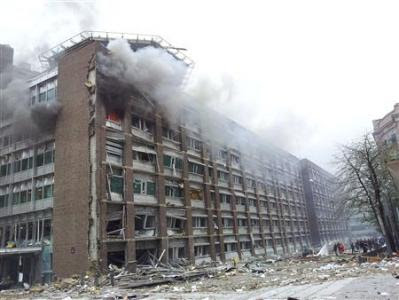
Debris is seen on the street after a powerful explosion rocked central Oslo, July 22, 2011.
REUTERS/Holm Morten/Scanpix
OSLO, July 22 (Reuters) - A massive bomb shattered Norway's main government building in Oslo Friday, killing two people police were quoted as saying by local news agency NTB.
There was no claim of responsibility, though NATO member Norway has been the target of threats, if not bombs, before, notably over its involvement in conflicts in Afghanistan and Libya. Prime Minister Jens Stoltenberg was safe, NTB said.
NRK radio said at least two people were killed in an attack that may have brought global political violence to the quiet Scandinavian city.
"It exploded -- it must have been a bomb. People ran in panic and ran. I counted at least 10 injured people," said bystander Kjersti Vedun, who was leaving the area.
A Reuters reporter at the scene said the blast scattered debris across the streets and shook the entire city center around 3:30 p.m. (9:30 a.m. EDT). He saw eight people injured, one covered in a sheet and apparently dead.
"So far I can confirm that we have received seven people at Oslo University Hospital," a press officer at the clinic said.
"I don't know how seriously wounded they are."
The explosion blew out most of the windows of the 17-storey central government building, cast a huge pall of smoke over the city and scattered shards of metal and other debris for hundreds of meters.
Nearby ministries were also hit, including the oil ministry, which was on fire. Heavy debris littered the streets.
John Drake, senior risk consultant, at London-based consultancy AKE said: "It may not be too dissimilar to the terrorist attack in Stockholm in December which saw a car bomb and secondary explosion shortly after in the downtown area.
"That attack was later claimed as reprisal for Sweden's contribution to the efforts in Afghanistan."
The Reuters correspondent said the streets had been fairly quiet in mid-afternoon on a Friday in high summer, when many Oslo residents take vacation or leave for weekend breaks.
The tangled wreckage of a car was outside one building, as well as the damage to the buildings, appeared consistent to witnesses with that from car bombs.
THREATS
NATO member Norway has sometimes in the past been threatened by leaders of al Qaeda for its involvement in Afghanistan. But political violence is virtually unknown in a country known for sponsoring the Nobel Peace Prize and mediating in international conflicts, including in the Middle East and Sri Lanka.
It has also taken part the NATO bombing of Libya, where Muammar Gaddafi has threatened to strike back in Europe.
David Lea, Western Europe analyst, at Control Risks said: "There certainly aren't any domestic Norwegian terrorist groups although there have been some al Qaeda-linked arrests from time to time. They are in Afghanistan and were involved in Libya, but it's far too soon to draw any conclusions."
(Additional reporting by Gwladys Fouche in Oslo and Peter Apps and William Maclean in London; Writing by Alister Doyle; Editing by Alastair Macdonald)
Forex: AUD/USD backs away from 10-week highs
Fri, Jul 22 2011, 14:19 GMT
FXstreet.com (Córdoba) - The Aussie has moved off its 10-week high reached earlier at 1.0873 against the Greenback as risk appetite is easing on Friday after the spike the markets enjoyed yesterday. AUD/USD fell around 35 pips from highs to the 1.0835 area where the correction was contained by the 20-hour SMA.
Despite the bearish correction, the Aussie is holding pretty well, supported by gold prices' sharp rise. At time of writing, AUD/USD is trading at the 1.0845/50 area, still 0.10% above its opening price.
"The overall bullish outlook remains intact for a rise to 1.10+ levels. Resistance-turned-Support is seen at 1.0800 and then significant Support is seen near 1.0730", comments the Kshitij Consultancy Services team. "A dip to 1.0750-30 if seen can attract fresh buying in the market. As mentioned in the morning, Aussie is gearing up for a rally to 1.10 or even higher in the coming days/weeks".
Wednesday, 20 July 2011
Anadarko-BP settlement deal not imminent -source
* BP shares firmer on rumor
* Anadarko declines comment
(Reuters) - A settlement between BP Plc and Anadarko Petroleum concerning liability around last year's Gulf of Mexico oil spill is not imminent, a source familiar with the dispute said.
Shares in BP had risen on market speculation that Anadarko Petroleum Corp will bring forward a settlement with the major British oil company.
The source familiar with the dispute said a settlement between BP and Anadarko was not imminent, and attributed the chatter about a potential deal to the release of the U.S. company's earnings, even though that release date had been set months earlier.
Anadarko declined to comment on the issue, citing its policy of not discussing market rumors. Its shares were up 1 percent at $83.13 on Wednesday morning. BP shares were up 2.8 percent in London.
Anadarko is scheduled to release second-quarter earnings on Monday after the market close.
Anadarko has maintained that it has a strong legal position and should face no liability in last year's spill, but Jim Hackett, the company's CEO, said in May that the company would discuss the issue with BP under the right circumstances.
A BP spokeswoman said: "We've always said that we expect our partners to pay their contribution and that's all we can say."
U.S. District Judge Carl Barbier in New Orleans on Monday put Anadarko's claims against BP on hold, citing a provision in the companies' operating agreement for the Macondo well that disputes be arbitrated.
Anadarko owned a 25 percent stake in the blown-out Macondo well. BP had asked Anadarko to help pay for some of the cleanup and recovery costs, but the company has refused. Anadarko then filed a lawsuit in April, claiming it was not at fault for the explosion and spill.
(Reporting by Matt Daily, editing by Matthew Lewis)
Monday, 18 July 2011
Gold futures rise above $1,600 an ounce
Worries over euro-zone crisis and U.S. debt ceiling boost gold
By Polya Lesova and Virginia Harrison, MarketWatch
LONDON (MarketWatch) — Gold futures rallied above $1,600 an ounce in electronic trading on Monday, as concerns about the euro-zone debt crisis and the lack of agreement on raising the U.S. debt ceiling prompted investors to seek a safe haven in the precious metal.
Gold for August delivery rose $7.90, or 0.5%, to $1,598 an ounce on the Comex division of the New York Mercantile Exchange in very early morning U.S. trading. Earlier in the day, the contract surged as high as $1,601.20 an ounce, according to data from FactSet.
Gold futures finished last week at a record nominal settlement price of $1,590.10 an ounce.
“European sovereign fears, combined with wrangling over raising the debt ceiling, have boosted safe havens,“ said Kathleen Brooks, an analyst at Forex.com, in a note.
“Recently gold has outpaced silver; however, with gold reaching a record $1,600 per ounce this morning, we think that silver may play catch up,“ she said.
In Europe, Italian and Spanish government bond yields rose sharply, as investors were spooked by the ongoing uncertainty over the ability of European officials to agree on a second aid program for Greece and stop contagion from Greece’s troubles to other countries such as Spain and Italy.
Investors tend to buy gold as a store of value during times of financial turmoil. Meanwhile, worries about rising inflation — enhanced by the possibility of the injection of further stimulus into the U.S. economy — have also supported gold, which is seen as an inflation hedge.
The impasse in U.S. debt ceiling talks has further added to gold’s appeal, as the Aug. 2 deadline for Congress to pass legislation to prevent a default loomed. Read the latest on debt-ceiling negotiations in Washington.
Silver rises
Silver for September delivery rose 82 cents, or 2.1%, to $39.90 an ounce on the Nymex.
Silver was the worst performer among precious metals in the second quarter, but it could outperform gold toward the end of the summer, according to Anne-Laure Tremblay of BNP Paribas.
“If current uncertainties about the debt deal in the U.S. and risks of contagion of the fiscal crisis in the euro zone subside, then the gold price, to which silver is tied, may be range-bound during the summer,” Tremblay said in a note.
“Silver could outperform gold once more toward the end of summer, and we would expect the gold-silver ratio to start declining once more as a result,” she said.
In other metals trading, copper for September delivery was unchanged at $4.41 a pound.
Meanwhile, the dollar index , which tracks the U.S. unit’s performance against a basket of six rival currencies, rose to 75.539, up from 75.148 in North American trade late Friday.
Polya Lesova is chief of MarketWatch’s London bureau. Virginia Harrison is a MarketWatch reporter based in Sydney.
Thursday, 7 July 2011
ECB signals more rate rises to come, helps Portugal
By Paul Carrel
FRANKFURT | Thu Jul 7, 2011 3:07pm BST
(Reuters) - The European Central Bank raised interest rates for the second time this year on Thursday and signalled further policy tightening to come to tackle inflation despite the euro zone's intensifying debt crisis.
But it offered help to hard-pressed Portugal after ratings agency Moody's downgraded its debt to junk status this week, committing to keep providing it with liquidity.
"We will continue to monitor very closely all developments with respect to upside risks to price stability," Trichet told a news conference after the bank raised interest rates by 25 basis points to 1.5 percent.
Economists said before the news conference that use of that phrase would signal a further rate rise in 2011, likely to be in the last three months of the year.
Euro zone inflation held at 2.7 percent in June, well above the ECB's target of just under 2 percent. Trichet said monetary policy remained accommodative even after Thursday's increase.
The rise in the ECB's benchmark interest rate to 1.5 percent was widely expected after the bank's recent reiterations that it was in "strong vigilance" mode -- code traditionally used to signal a hike.
"No surprise at all," Berenberg economist Holger Schmieding said of Thursday's quarter-point rise.
The ECB raised its subsidiary overnight deposit and borrowing rates in unison, opting not to re-widen its so-called rate 'corridor' this time around.
Recent euro zone data has generally disappointed. The latest industrial orders rose less than expected, while growth in the bloc's dominant service sector has also slowed sharply.
A Reuters poll found economists have softened their rate hike view as the euro zone debt crisis has escalated over the last month.
The ECB's key rate is expected to rise just once more this year, to 1.75 percent, with only two quarter-point increases forecast to follow for all of next year.
In contrast, the Bank of England kept rates on hold on Thursday.
HELPING HAND TO PORTUGAL
The downgrading of recently bailed-out Portugal's credit rating to junk rattled financial markets on Wednesday and cast new doubt on European efforts to rescue distressed euro zone states without debt restructuring.
The ECB has pledged to keep liquidity flowing to euro zone banks that need it, and Trichet said Portuguese debt would be accepted by the ECB as collateral for now, come what may.
"We have decided to suspend the application of the minimum credit rating threshold ... for the purpose of Eurosystem credit operations in the case of marketable debt instruments issued or guaranteed by the Portuguese government," he said.
"This suspension will be maintained until further notice."
The ECB has proved a major stumbling block in agreeing a second rescue plan for Greece as it has threatened to refuse restructured Greek bonds as collateral in its lending operations in the event of a default or a "restricted default," which ratings agencies are threatening to impose.
"We say no to selective default," Trichet said.
Refusing to accept Greek bonds as collateral would deprive Greek banks of the funds on which they rely, crippling the Greek economy and risking contagion to other euro zone economies. Most economists expect the ECB to baulk at that and keep banks afloat somehow.
(Editing by Mike Peacock)
Wednesday, 6 July 2011
Gold futures gain more than $20 an ounce
Silver tracks gold higher, but copper, platinum, palladium prices slip
SAN FRANCISCO (MarketWatch) — Gold futures gained more than $20 an ounce Wednesday, extending sharp gains made the previous day in New York, with global-debt troubles back on center stage.
Gold for August delivery was up $20.10, or 1.3%, at $1,532.80 an ounce on the Comex division of the New York Mercantile Exchange. The contract, which earlier touched a high of $1,534.50, hasn’t traded at levels this high since June 22.
Prices for the precious metal jumped more than $30 an ounce in regular trading on Tuesday, buoyed by safe-haven buying as Europe’s debt issues reemerged as a concern for investors.
“The persistent debt problems in both Europe and the U.S. are a big part of gold’s gains this week,” said Peter Grant, senior metals analyst at USAGold-Centennial Precious Metals Inc.
“It’s quickly becoming a question of credibility,” he said. “As the troika flails about trying to mitigate the Greek crisis without creating a default, they erode market confidence. That waning confidence in the troika has resulted in contagion to Portugal in the wake of yesterday’s downgrade.”
On Monday, the Standard & Poor’s credit-rating firm signaled that a plan to roll over Greek-government debt would constitute a “selective default.” Then on Tuesday, Moody’s Investors Services downgraded Portugal’s credit rating by four notches to speculative grade.
Also contributing to gains in gold is the local-government-debt story in China, said Grant: “Investors are worried that if China turns inward to address their own debt woes, it may be at the expense of Europe and America.”
The People’s Bank of China lifted lending and deposit rates 0.25 percentage point on Wednesday, marking the third such adjustment this year.
Seasonal surge
The focus, however, remains on debt problems in Europe and the U.S.
“Gold’s current strength signals that something’s very seriously amiss on both sides of the Atlantic,” said Adrian Ash, head of research at BullionVault.com, an online service for gold-bullion trading and ownership.
He points out that gold bulls typically take a holiday in July through September, thanks primarily to the seasonal lull in Indian demand but also thanks to the broader “sell in May” drop-off in all financial trading.
“But if Greece, Portugal and the U.S. debt-ceiling ruckus don’t allow that typical pullback to come through, gold prices could run straight onto their very typical autumnal surge,” said Ash. “India’s festive demand will then return, running straight onto China’s heavy New Year gold buying in January/February.”
For now, U.S. and euro-zone debt looks likely to dominate traders’ views in the coming days, but players will also be paying close attention to key U.S. jobs data this week, and to Thursday’s rate meetings by the European Central Bank and Bank of England, said James Moore, analyst at TheBullionDesk.com, in a note to clients Wednesday.
Weekly filings for unemployment benefits are due out from the Labor Department on Thursday, followed by figures on U.S. joblessness and growth in nonfarm payrolls for June on Friday.
Gold prices gained more ground shortly after the Institute for Supply Management said its U.S. services-sector index for June fell to 53.3% from 54.6% in May. Economists surveyed by MarketWatch had expected a dip to 54%; a reading over 50% indicates that more firms in the survey are expanding than contracting.
In other metals action on Wednesday, September silver rallied 71 cents to $36.12 an ounce, while September copper declined 0.6 cent to $4.34 per pound.
September palladium traded flat at $775.65 an ounce, while October platinum declined $3.40 to stand at $1,738.70 an ounce.
Myra Saefong is a MarketWatch reporter based in San Francisco. Sarah Turner is MarketWatch's bureau chief in Sydney.
Tuesday, 5 July 2011
The Week That Was ;BP Plc, Deutsche Tel, Banco Popolare, Copper
It has been a slow 7 days as the 2nd quarter came to an end without too many headlines apart from the Dow Jones Industrial Index (DJIA) shooting above its 1200 points resistance. The ugly Greece debt crisis also came within manageability this week.
The Blue Chips 2011 Portfolio
Bp Plc is finally in the green after the stock rose 1% above the opening price of 455.60p.This stock has been boosted by the easing of the Eurozone debt crisis. Also ,the compensation fund for the Mexican Gulf oil spill is being boosted by the chipping in of associates such as Mitsui. Oil price volatility has also eased due to the IAEA intervention to boost oil supply of which BP is part of the oil bigs bidding for this extra supply.
Deutsche Tel has improved its position riding on the back of the Euro stocks’ resurgence after Greece approved austerity measures to deal with its debt crisis. This means that some of our long positions are now in the green. It also stands to gain even if the US FCC (Federal Commission of Communication) and the Department of Justice stop its sale of T-Mobile since the acquirer, AT & T has agreed to pay Deutsche Tel $6 billion if the deal falls through.
However, if the deal is passed, Deutsche Tel is in line for a $39 billion payoff which means the share price should ride an upward trend till the deal is sealed next spring. The stock is currently trading at €10.6.
Banco Popolare Societa Cooperativa
We closed the Banco Popolare trade on Tuesday 29th June at €1.52 yielding a return of 22%.We are now contemplating going long into it as its fortunes look to be better. Its management have just given a very positive earnings forecast arising from its restructuring. They anticipate job cuts in the near future but a return to profit growth in the next 12 months. The stock is currently trading at €1.62.
Blue Chips has also gone long into its first metal this year-copper at an opening price of$4.2568. This shows that the portfolio is healthy enough to withstand the volatility that comes with commodity markets. Copper is actually less volatile than gold in the market which has come from highs of $1571 in May to a low of $1482/oz attributable to the resolution of the Greek crisis. This may change however as the overall Eurozone debt issue is far from settled as Portugal, Spain & now Italy remain in the spotlight.
The issue is also bound to affect the Blue Chips portfolio if we decide to go long into Banco Popolare due to Moody’s threat of downgrading Italy’s debt.2 Italian stocks-Intesa & UniCredit- recently suffered a ‘flash crash’ recently in relation to this threat.
Whether or not Blue Chips extends its stay in Europe, a very exciting trading week lies ahead of us.
Regards,
James Mwangi
Subscribe to:
Posts (Atom)